Senator Malcolm Roberts blasts government over smart meter rollout and calls for Inquiry

Senator Roberts’ powerful speech in parliament on 24 November 2025 pointed out that three years ago One Nation had told the country:

That’s control of your electricity use in the government’s hands and in energy company hands, including foreign multinational companies. That is control of your electricity and your access to it—whether you can use it and what you can use it for. This is only possible with the now mandatory rollout of smart meters, which are internet connected electricity meters.’

Continue reading
Posted in Smart Meter | Tagged , , , , , , , , , , , , | 11 Comments

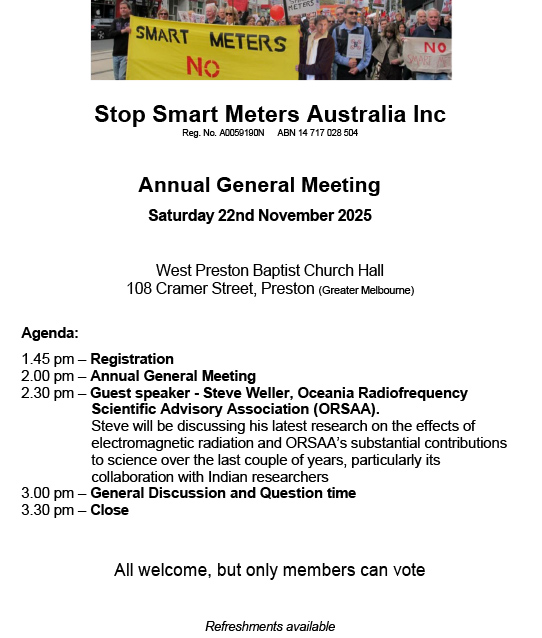
SSMA Annual General Meeting – 22nd November 2025

Posted in Smart Meter | Tagged , , , , | 3 Comments

You have a right to a non-communicating smart meter…

The Australian Energy Regulator (AER) clearly states in its Guidance to retailers that consumers have the right to a Type 4A non-communicating smart meter when deploying or replacing smart meters under the National Energy Retail Rules and National Electricity Rules. However, it seems that many retailers are ignoring this and advising customers they have no choice but to accept a smart meter with an active communications card that emits electromagnetic radiation 24/7.

The following extract is from the AER’s Guidance to retailers:

WA’s Western Power, although not part of the national electricity market, also clearly specifies in its FAQ webpage that customers can request to have the communications device removed (with certain exceptions) from their meter at any time.

Unfortunately, in Victoria, where smart meters were mandated via Victorian Government Orders in Council, consumers do not have the same rights as other Australians. Once a smart meter is installed, they rarely are able to have the communications card removed and have meters read manually.

Posted in Smart Meter | Tagged , , , , , , , , , , , | 19 Comments

AMPS report calls for the Australian Government to withdraw from the World Health Organization

An independent investigation into the World Health Organization (WHO) by the Australian Medical Professionals’ Society (AMPS) has recommended that the Australian Government, administrators and medical authorities recognise that the ‘WHO is a compromised body with conflicted interests that is allowing donors to purchase influence’. 

AMPS’s 46-page report, titled ‘Follow the Money’, focuses on how pharmaceutical companies influence global health policy through their donations to the WHO. AMPS calls for the Australian Government to withdraw from the WHO until such time as the WHO can be demonstrated to be free of conflict of interests.

As our members and followers know, it isn’t just the funding from pharmaceuticals that has corrupted the WHO. It’s also the financial reach of the telecommunications industry into the WHO that has caused the WHO to abandon its remit of protecting global health. This has been covered in earlier posts, such as The WHO cover-up on the truth about wireless radiation.

Sadly, Australian government minions appear to be unaware of the WHO’s suppression of the harm caused by wireless radiation. Instead, they naively promote the WHO as a trustworthy authority, trotting out copy-and-paste sentences such as the following, ‘Regarding your concerns around health effects, health authorities around the world, including the World Health Organization (WHO), have indicated that there are no established health effects from smart meters’. 

The AMPS report recognises that there are many ways of supporting public health that do not involve pharmaceuticals. Some of the ways pointed out are building immunity, good sleep, healthy homes and EMF-free environments. SSMA agrees and adds that EMF-free environments naturally promote building immunity, good sleep and healthy homes.

Whilst it is sad that the WHO has long ago lost its way and prostituted itself to industry interests, it is encouraging that AMPS, Australia’s largest voluntary association of doctors, has undertaken the research to prove this. We also applaud AMPS for recognising the value of EMF-free environments in supporting public health.

To download AMP’s press release, go to: https://amps.redunion.com.au/news/follow-the-money-commercial-interests-influence-global-health-policy

To read the report, ‘Follow the Money’, go to: https://amps.redunion.com.au/hubfs/Follow%20the%20Money%20-%2022June25%20FINAL.pdf

Posted in Smart Meter | Tagged , , , , , , , , , , , , , | 6 Comments

The NSW government states…

In answer to its Frequently Asked Question, “I still don’t want a smart meter. What can I do?”:

If you don’t want a smart meter, you can ask your retailer to have the ‘smart’ or remote telecommunications function turned off either before it is installed or after it has been installed.

A smart meter that does not transmit data remotely is known as a Type 4A meter … It will record your electricity usage and will need to be read manually by a technician…

See: https://www.energy.nsw.gov.au/households/guides-and-helpful-advice/being-more-energy-efficient/measuring-your-usage/using-smart

A NSW resident’s experience of removing the communications from a smart meter follows:

“I have recently moved into a short-term rental and had the communications antenna removed from my digital meter which was fully ‘smart’ before then. This was a super simple process. I rang AGL, my providers, asked about the process, got put through to the appropriate department which emailed me under ‘Solar Reconfigurations’ (not sure why the department is called this) and requested the removal of the communications aspect. They told me it would require either a remote ‘switching off’ which would only cost about $15 or for a technician to come and remove part of the meter which would cost around $200 and they weren’t sure which I’d need but would let me know.

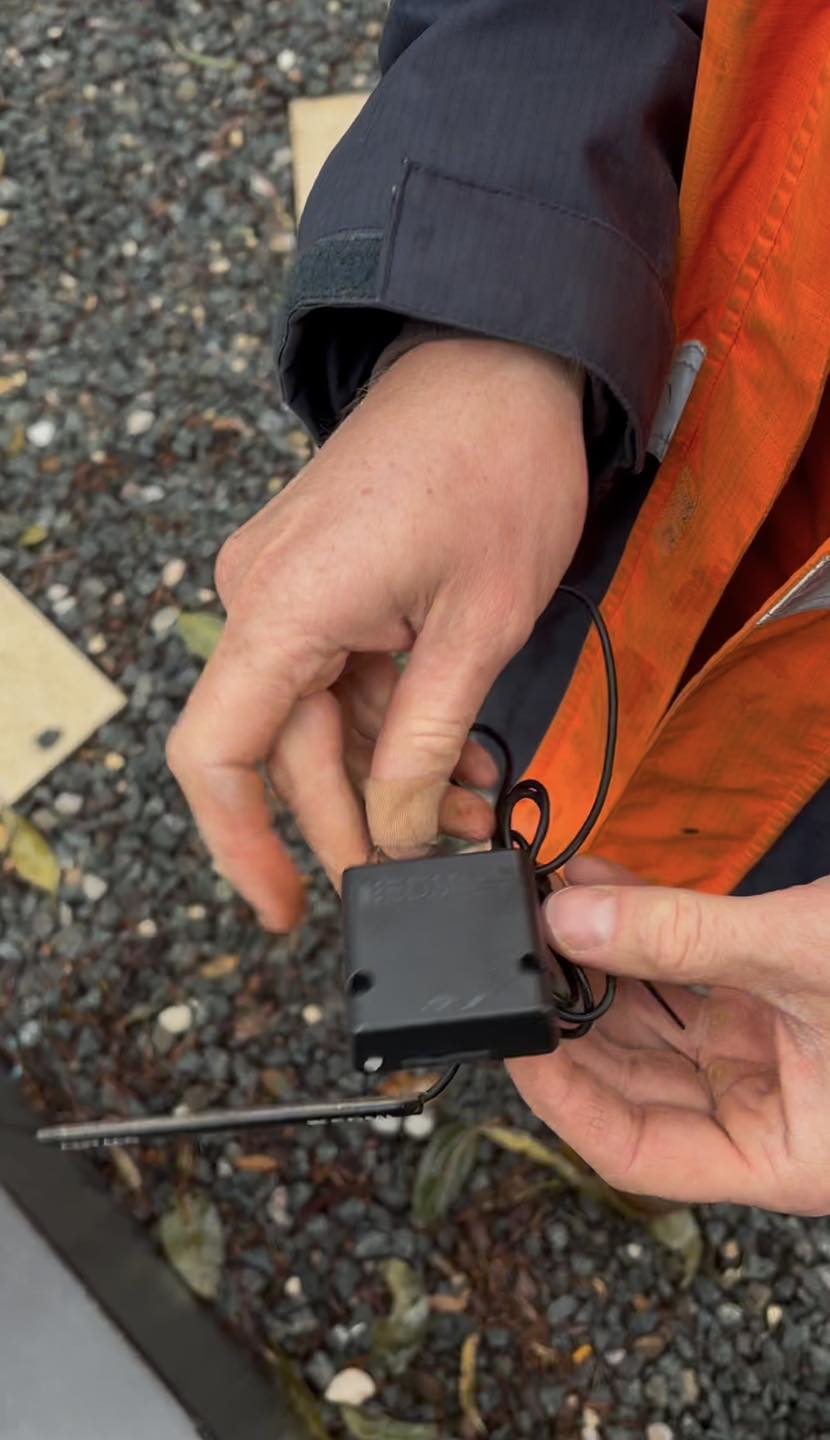
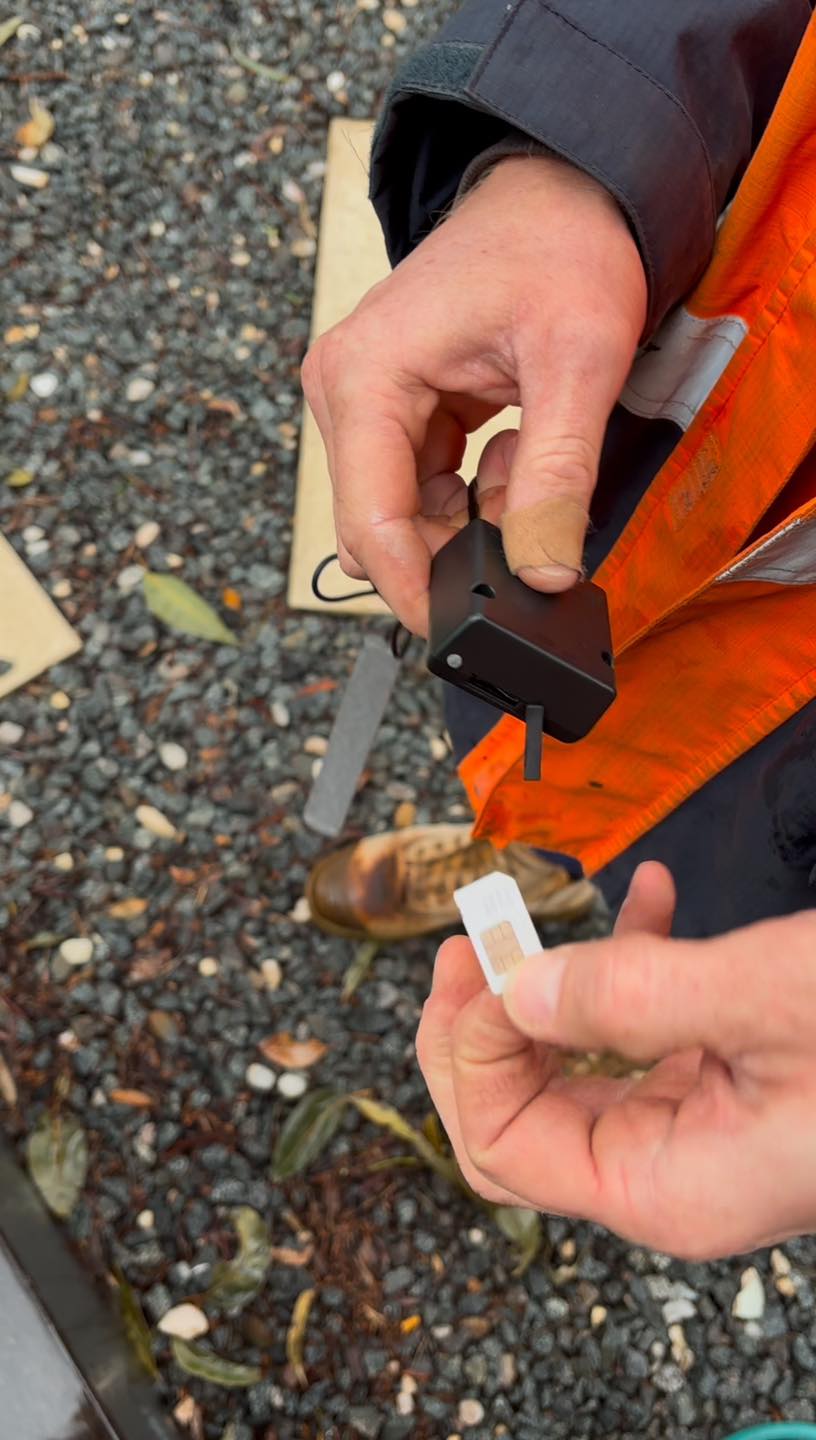
A week after moving in a technician arrived and kindly allowed me to take a photo of the modem he removed and opened it up to reveal the SIM, which was the part of the meter communicating with mobile phone base stations about my energy usage constantly during the day/night.

Technically my digital meter is still ‘smart’ in that when someone comes to ‘read’ the meter, much more information is taken. For example today a technician came and used a plug-in device that was Bluetooth-connected to his phone, whereupon he told me data was being transmitted about my usage – more than what would occur with the simple reading of my old analogue meter.

We used this time to discuss the biological health impact of EMF – he was quick to dismiss what I gently began to share by warning me about the Sun 🌞 (that old chestnut!) but eventually we had a conversation about the $25 million National Toxicology Program study, funded by the US gov and the development of malignant cancers in male rats when exposed to radiation from 3G phones. Good time well spent even if he was relieved when I finally left him alone and went back inside. Bless 🤣.”

Pics:

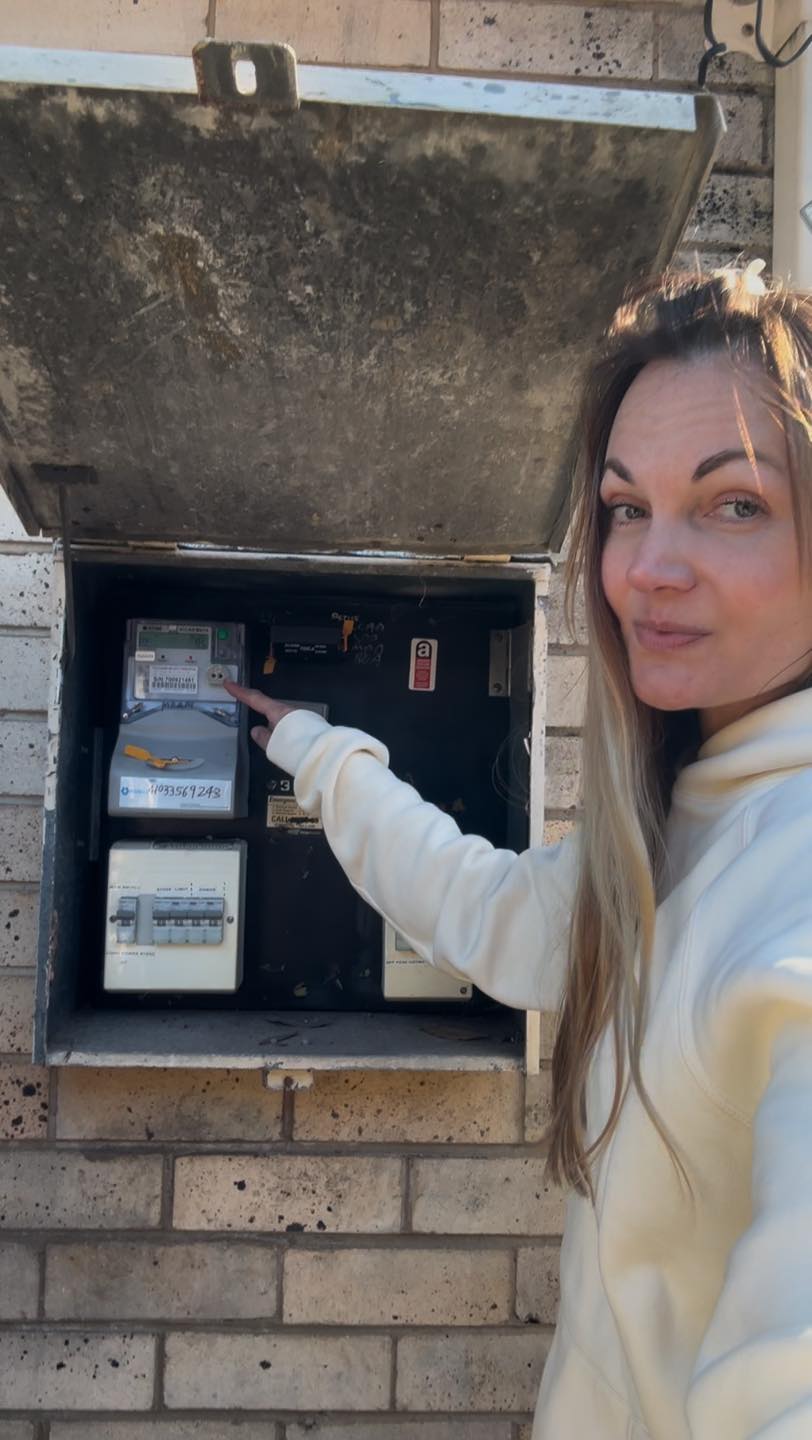
1. I’m pointing to the area the technician plugged his device into which then was connected to his phone when taking my meter reading.

2. The technician showing the removed modem from my smart meter.

3. The technician showing the SIM which was inside the modem.

Source: Facebook ‘Removing “Comms” from Smart Meters’, June 16 2025

Posted in Smart Meter | Tagged , , , , , , , , , , , | 8 Comments

NSW energy watchdog bemoans ‘confusion, broken trust’ as smart meter rollout sputters

An energy watchdog has sounded the alarm over the rollout of smart meters in Australia’s most populous state, saying too many consumers are being hit with poor service and left worse off.

The New South Wales Energy and Water Ombudsman is the latest body to shine a light on shortcomings in the deployment of smart meters to millions of homes across the country.

The NSW Ombudsman noted with some disbelief that there had been a big jump in the number of complaints it received about estimated power bills.

This was despite the fact smart meters, which had been installed on almost half of all homes in NSW, were supposed to ensure timely, accurate meter readings that could be done remotely, eliminating the need for estimated bills.

The watchdog said there had also been a major increase in the number of complaints related to sudden, unexplained changes to people’s electricity tariffs.

Such changes often involved customers being switched from flat rate prices, where they paid the same rate for a unit of power no matter when they bought it, to complex and dynamic charges.

Among these were time-of-use tariffs, in which customers paid more for power at peak times, and demand charges, which involved charging someone based on their single biggest half-hour of use across an entire month.

Ombudsman Janine Young also took aim at changes to metering that were supposed to give consumers more control over their consumption while allowing them to reduce their bills.

“The smart meter rollout aimed to increase flexibility and customer engagement with the energy market, by allowing customers to manage their energy usage and save money,” Ms Young said.

“But we aren’t seeing evidence of this in complaints that come to [the ombudsman], in fact, we are seeing the opposite.”

Of particular concern to Ms Young were changes to metering that allowed unregulated private companies to provide the service.

Previously, network poles-and-wires companies such as Ausgrid and Endeavour Energy were responsible for installing and managing meters on customers’ properties.

However, Ms Young noted that the Power of Choice reforms had ushered in completely different rules in which new, and largely unaccountable, players had entered the mix.

Ms Young said consumers with any complaints or queries about smart electricity meters should contact her office on 1800 246 545.

By ABC energy reporter Daniel Mercer

Abridged from: https://www.abc.net.au/news/2025-04-07/nsw-energy-ombudsman-sounds-alarm-at-smart-meter-rollout/105140486

Posted in Smart Meter | Tagged , , , , | 1 Comment

French court rules against the forced installation of smart meters

The Lyon Administrative Court issued a landmark decision in February 2025, requiring Enedis to remove a Linky [smart] meter installed against a private individual’s wishes. This ruling marks a major turning point in the years-long standoff between some citizens and the French electricity grid manager. Pierre Cascina, a resident of the Loire region, won his case after demonstrating a significant deterioration in his health following the forced installation of the communicating device in 2022.

The right of refusal recognised by the courts in the face of smart meters

The Cascina case represents a significant legal precedent in smart meter litigation. The Lyon judges granted unprecedented legitimacy to the subjective suffering of the plaintiff, who reported persistent migraines and sleep disturbances since the Linky system was installed in his home. This judicial recognition is based on the precautionary principle, despite the absence of a definitive scientific consensus on the health effects of the emitted waves.

The ruling seriously undermines Enedis’s policy, which until now relied on the regulatory compliance of its equipment to systematically reject any dispute. “This decision opens a significant breach in the electricity distributor’s strategy,” analyses Jeanne Duvernet, an environmental law specialist. “From now on, the suffering experienced becomes an admissible argument in court, regardless of technical standards.”

Consumer advocacy groups welcome this legal breakthrough, which could benefit the approximately 1,200 similar cases currently being prepared. This unprecedented citizen mobilization is already forcing authorities to reconsider their regulatory approach to digital infrastructure imposed in private homes.

The Defender of Rights had also emphasized in its 2024 report that “the right to refuse must adapt to contemporary technological realities.” This prescient position is now finding concrete expression in the courts, redrawing the contours of technological consent.

Growing tension between energy transition and health protection

The emblematic case of Pierre Cascina perfectly illustrates the dilemma facing public policy: how to reconcile the essential modernization of electricity networks with the protection of populations potentially sensitive to electromagnetic radiation? An INSERM study published in January 2025 reveals that 67% of French people now demand greater protection against artificial waves in their daily environment.

While Enedis highlights the environmental benefits of smart meters, including a 30% reduction in CO₂ emissions linked to the optimization of electricity distribution, medical voices are raising the alarm about the potential risks. Dr. Fenech, a specialist in the health impacts of wireless technologies, has been discussing the “invisible accumulation” of radiation in modern homes since 2023.

Faced with this growing controversy, the government has scheduled a multidisciplinary audit for June 2025. This exceptional commission will bring together doctors, lawyers, and representatives of civil society with the mission of developing a more balanced regulatory framework capable of addressing health concerns without compromising the objectives of the energy transition.

The administrative court’s decision fundamentally calls into question our collective relationship with imposed technologies. It could profoundly redefine several regulatory aspects: the legal obligations incumbent on operators of essential infrastructure, the criteria for assessing the health impacts of technologies deployed on a large scale, and the complaint mechanisms available to citizens.

Outlook for the deployment of Linky meters

Despite this legal defeat, Enedis officially maintains its position regarding the compliance of its equipment. The company regularly reiterates that Linky meters strictly comply with European standards, with emissions limited to 30 V/m , compared to the 87 V/m permitted by current regulations.

However, internal sources reveal that management discreetly initiated a working group in January 2025 to seek technical alternatives for users who declare themselves electrosensitive. This pragmatic approach reflects a growing awareness of the health and legal issues raised by the mass deployment of smart meters.

The future of the Linky meter now appears to be moving toward a more flexible model, where individual consent could regain a central role. “It’s not about abandoning network modernization, but about inventing solutions tailored to individual circumstances,” explains Antoine Marchand, an energy policy expert.

This legal victory against Enedis marks the emergence of a new balance between technological progress and respect for individual freedoms. It underscores the importance of a constructive dialogue between citizen skepticism legitimised by the courts and ecological imperatives defended by institutions. This complex challenge will have to be addressed by future legislation on imposed technologies, as the digitalisation of our daily environment intensifies.

Translated from: https://www.gre-mag.fr/victoire-enedis-tribunal-tranche-defaveur-linstallation-forcee-compteurs-linky/

Posted in Smart Meter | Tagged , , , , , | 4 Comments

“Smart Attack” – This animation reveals the truth about smart meters….

Posted in Smart Meter | 9 Comments

Smart meter scam: Hidden health dangers, inaccurate readings, and legal battles exposed

Millions of so-called smart meters have already been installed in homes across the United States, and the number is increasing daily.  Although some herald them as an ‘energy-efficient’ way to help consumers reduce electric bills, many public health and safety advocates are fighting to expose the grim truth: “smart” meters present a grave threat to human health and personal privacy.

Now, research reveals that these brand-new digital meters – being placed on homes worldwide – can be wildly inaccurate in their energy usage assessment, costing consumers significantly more in energy bills.  Furthermore, growing legal opposition highlights additional risks.

legal brief filed with the New Mexico Public Regulatory Commission details how smart meters negatively impact human health and wildlife due to the radiofrequency (RF) radiation they emit.  The brief, submitted by New Mexicans for Utility Safety, argues that public concerns over severe health effects and environmental harm have been largely ignored in regulatory proceedings, reinforcing the urgent need for greater scrutiny of these devices.

Dutch study yields jaw-dropping results about smart meters

Just as in America, smart meters, or “static energy meters,” are replacing traditional electromechanical energy meters across the Netherlands.

In both the United States and the Netherlands, many consumers have insisted that the new electronic energy meters yield excessively high readings.  In a study published in the scientific journal IEEE Electromagnetic Compatibility Magazine and conducted by the University of Twente and the Amsterdam University of Applied Sciences, researchers found that they were right.

To conduct the study, lead researcher Franz Leferink, a Professor of Electromagnetic Compatibility at the UT, tested nine different electronic meters manufactured between 2004 and 2014.  The meters were connected via electric switchboard to various power-saving devices, including energy-saving light bulbs, heaters, LED bulbs, and dimmers.  The team then compared actual energy consumption with the readings furnished by the electronic meters.

The results were profoundly disturbing.  Five of the nine meters – more than half – gave readings higher than the actual power consumed – in some cases, a staggering 582 percent higher.  Other readings were 475 percent, 566 percent, 569 percent, and 581 percent higher than actual use.  This could theoretically reflect a nearly sixfold increase in a utility bill – a rip-off of outrageous proportions!

In contrast, only two of the meters gave inaccurate readings that were as much as 32 percent lower than the actual power consumed.

Incompatibility problem causes serious errors

The researchers believe they discovered a design flaw in the energy meters.  This flaw became apparent when the meters were used with modern, energy-efficient switching devices, which create non-linear, fast-switching electrical loads.  The greatest inconsistencies were seen when dimmers, combined with energy-saving light bulbs and LEDs, were tested in the system.

When switching devices are used, the electricity no longer exhibits a perfect waveform but develops an erratic pattern – something the designers of the new meters did not allow for.  After disassembling the meters, the researchers determined that meters containing a “Rogowski coil” current sensor delivered excessive readings.  In contrast, those with low readings used a “Hall effect-based” current sensor.

A way of legally protecting yourself from harm

Professor Leferink noted that consumers who feel their meters are giving faulty readings can have them tested by an accredited inspection company.  However, if the inspection shows that the meter is functioning properly, the consumer will have to pay all costs involved in the inspection.

A more pressing problem is that the standardized test doesn’t account for waveform-distorting power-consuming appliances, making it unreliable for detecting false readings.  The researchers advise consumers who suspect inaccurate meter readings to contact their supplier, who will pass the complaint on to the power grid operator.

However, there is another solution – you can legally refuse to have a smart meter installed.

The suppressed truth: Smart meters emit dangerous amounts of toxic radiation

Residential smart meters emit non-ionizing microwaves at 10,000 to 200,000 pulses per meter daily – a relentless bombardment that leaves the body no time to recover or repair the damage.  In fact, this is the radioactive equivalent of 160 cell phones.  Repeated exposure to excessive radiation can trigger migraines, neurological conditions, and various types of cancer.

The American Academy of Environmental Medicine has called for a moratorium on smart meters until the health effects can be adequately studied.

In the film Take Back Your Power, independent researcher Dr. Frank Springbob studies blood samples taken from volunteers after one minute of exposure one foot away from a smart meter and detects misshapen and clumping red blood cells – a clear sign of free radical damage.

Not surprisingly, utility companies continue to deny that smart meters emit radiofrequency radiation at a high enough level to cause illness.

Although the term “smart meters” seems to impart an aura of intelligence and trustworthiness, these sinister devices are a major part of a multi-trillion-dollar scam perpetrated in the name of “climate action” and grid modernization.  The “powers that be” know this and hope they will not be called to account by informed and empowered people.

Lori Alton, Natural Health 365

Source: https://www.naturalhealth365.com/smart-meter-scam-hidden-heath-dangers-inaccurate-readings-and-legal-battles-exposed.html

Posted in Smart Meter | Tagged , , , , , | 1 Comment

New Report Contradicts Telecom Industry Claim That Wireless Radiation Is Safe

A new peer-reviewed scientific report outlines a mechanism by which non-ionizing radiation can disrupt the biology of living systems, even at levels much lower than what’s needed to heat tissues. The telecom industry has consistently claimed that non-ionizing radiation is harmless to human health.

The basis for the wireless industry’s claim that radiation is safe for humans is scientifically erroneous, according to the author of a new peer-reviewed scientific report.

Paul Héroux, Ph.D., authored the report, which was published Jan. 30 in Heliyon, one of Elsevier’s journals on its ScienceDirect platform.

Héroux, an associate professor of medicine at McGill University in Montreal, Canada, and a medical scientist in McGill University Health Center’s surgery department, has years of experience in physics and electrical engineering.

He is also vice chair of the International Commission on the Biological Effects of Electromagnetic Fields (ICBE-EMF), a “consortium of scientists, doctors and researchers” who study wireless radiation and make recommendations for wireless radiation exposure guidelines “based on the best peer-reviewed research publications.”

Héroux told The Defender:

“Industry’s most important argument to deny the health impacts of electromagnetic radiation has been that these health effects are impossible based on solid physics, specifically that the radiation is ‘non-ionizing.”

Héroux detailed the scientific faultiness of that argument:

“Ionization by the radiation itself is irrelevant because life processes produce ionization within the body itself.

“In fact, the basic laws of physics (Maxwell’s Equations and the Second Law of Thermodynamics) together with established biology confirm that health effects of electromagnetic radiation are in fact inevitable, and at levels much lower than those considered safe by industry.”

Dr. Robert Brown, a diagnostic radiologist with more than 30 years of experience and the vice president of Scientific Research and Clinical Affairs for the Environmental Health Trust (EHT), praised Héroux’s report.

Brown said the report “effectively outlines a mechanism by which non-ionizing radiation can disrupt the biology of living systems” — even at levels much lower than what’s needed to heat tissues.

Fariha Husain, manager of Children’s Health Defense’s (CHD) Electromagnetic Radiation (EMR) & Wireless Program, called the report “groundbreaking.”

“Héroux’s report fundamentally challenges the flawed ‘thermal-only paradigm,’ which falsely claims that non-ionizing radiation — including radiofrequency (RF) radiation emitted by Wi-Fi routerscell towerssmart meters and cellphones — can harm biological tissue only via excessive heating,” Husain said.

The report is novel in that it systematically breaks down the flawed industry arguments used to justify the thermal-only paradigm.

“But the truth of the matter is that the harm caused by RF radiation has been known for decades,” Husain said. “Unfortunately, this knowledge has been intentionally suppressed by industry.”

The wireless industry and regulatory agencies, including the Federal Communications Commission (FCC) andthe International Commission on Non-Ionizing Radiation Protection (ICNIRP), contend that harm can occur only at radiation levels high enough to cause tissue heating.

Lawyers with CHD and EHT in 2021 successfully showed before the U.S. Court of Appeals for the District of Columbia Circuit that the FCC ignored massive scientific evidence suggesting that RF radiation has negative biological effects at levels currently allowed by the FCC.

CHD and EHT’s historic case alleged that the FCC failed to provide a reasoned explanation for its determination that its current RF exposure guidelines — which haven’t been updated since 1996 — adequately protect against the harmful effects of exposure to RF radiation.

The FCC has yet to comply with the court’s mandate to explain how the agency determined that its current guidelines adequately protect humans and the environment against the harmful effects of exposure to wireless radiation.

Studies on dead tissues can’t detect health effects

In the report, Héroux provides a scientific rationale for why biological harm occurs at non-thermal levels of RF radiation.

Brown summarized key parts of that rationale:

“Héroux initially explains the difference in physical distance between redox reactions occurring in inorganic matter and those occurring in living systems. The ongoing processes of glycolysis and oxidative phosphorylation require electrons and protons to continually engage long pathways in mitochondria to produce chemical energy from the breakdown of sugars.

“He clearly details why it is this increased distance that makes living systems vulnerable to the effects of non-ionizing radiation.

“I believe Dr. Héroux has presented a compelling case that non-ionizing radiation can impact the path of these charged particles and affect not only the efficiency of energy production in the cell but also increase the production of reactive oxygen species, which can lead to cellular oxidative stress.”

Oxidative stress due to RF radiation exposure has been “clearly documented” in the scientific literature, Brown added.

Héroux said his report also shows that the FCC’s safety assessments of RF radiation failed to consider basic physics in addition to its biological effects.

The current regulatory limits “completely ignore” this science, Husain said. “The expansion of wireless technology is in direct conflict with protecting public health and the environment and it is long overdue for regulators to acknowledge the growing body of evidence and take immediate action to establish safety standards that protect both human health and the environment.”

The report also explains why health effects from non-ionizing radiation cannot be detected in experiments performed on dead tissue.

“No electron transport occurs in dead tissue, regardless of whether or not it is ‘fresh.’” Brown said. “Research performed on the effects of electromagnetic radiation on dead tissue has led to erroneous conclusions in many in vitro scientific studies.”

Scientists call out WHO-funded study for ‘serious flaws’

Héroux published his report just weeks after he and other scientists with ICBE-EMF published a scathing letter to the editor of Environmental International criticizing a recent systematic review funded by the World Health Organization (WHO) that claimed it found no link between cellphone use and brain cancer.

The study — part of a WHO-commissioned series of scientific reviews of the possible health risks of wireless radiation — was available online Aug. 30, 2024, in Environmental International.

In their letter, the IBCE-EMF scientists said the WHO’s study had “serious flaws” that undermined the validity of the study’s conclusions.

“It is dishonest to assure the public that cell phones and wireless radiation are safe based upon such a flawed review,” said Joel Moskowitz, Ph.D., in an ICBE-EMF press release.

Moskowitz is director of the Center for Family and Community Health at the School of Public Health, University of California, Berkeley, and an ICBE-EMF member.

The WHO commissioned 10 systematic reviews on the evidence of the health risks from wireless radiation, according to the ICBE-EMF.

So far, nine have been published. All “suffer from serious methodological problems and seem biased to dismiss the substantial evidence of health risk reported in the peer-reviewed scientific literature,” Moskowitz said in a Sept. 30, 2024, presentation.

Once all 10 are published, the WHO plans to use the reviews as the basis for updating its 1993 Environmental Health Criteria Monograph” on RF-EMF, ICBE-EMF said.

“A monograph is a report which overviews the scientific evidence on biological effects, identifies gaps in knowledge to direct future research and provides information for health authorities and regulatory agencies regarding public health,” according to ICBE-EMF.

In a post on his Electromagnetic Radiation Safety website, Moskowitz noted that all of the WHO’s scientific review teams have one or more ICNIRP members.

ICNIRP, which Moskowitz called a “cartel,” is a German nonprofit that issues RF radiation exposure limits “produced by its own members, their former students and close colleagues.”

According to EHT, ICNIRP is an invite-only group with “deep industry ties” and no oversight.

Scientists in 2020 sent a letter to the WHO’s leadership asking how the research teams were selected but did not receive a response, according to EHT.

Suzanne Burdick, Ph.D.

Source: https://childrenshealthdefense.org/defender/new-report-contradicts-telecom-industry-claim-wireless-radiation-safe/

Posted in Smart Meter | Tagged , , , , | Leave a comment